September 14, 2026

Overview
Hong Kong
Hong Kong Tiananmen Vigil Organizers Convicted After Nearly 5 Years in Custody
By Contributor Tsz Leung Yiu
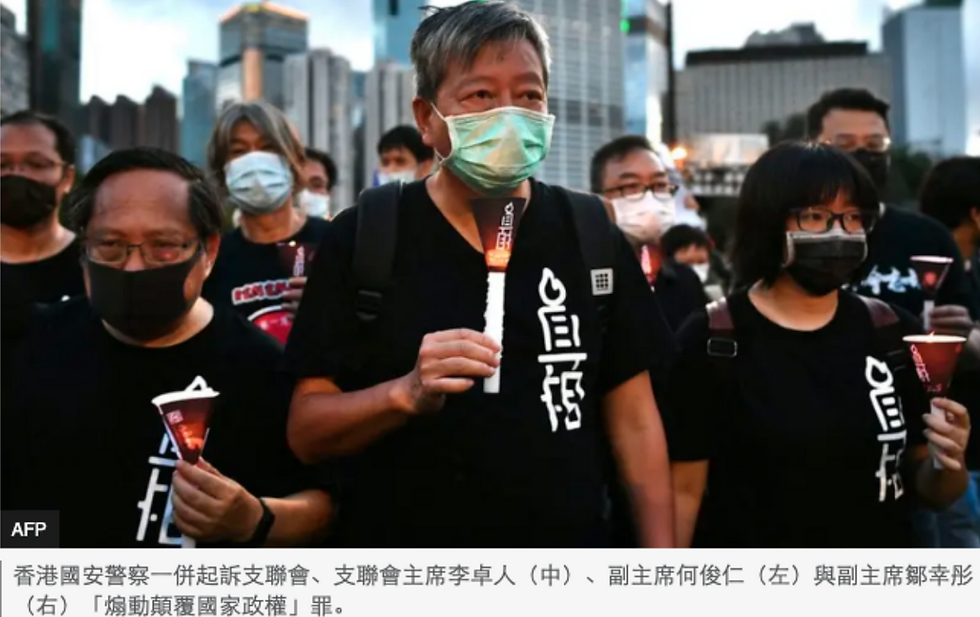
Lee Cheuck-Yan (Middle), Ho Chun-Yan (left), Chow Hang-Tung(Right) image via(BBC)
The High Court: On 21 Aug 2026, Hong Kong’s High Court found Lee Cheuk-Yan and Chow Hang-Tung guilty of Incitement to Subversion under the Hong Kong National Security Law. The defendants were former leaders of Hong Kong Alliance in Support of Patriotic Democratic Movement of China, an Organization best known for rehabilitating the 1989 pro-democracy movement, release all political prisoners, and end one-party dictatorship to build a democratic China. The court ruled that their “Ending one-party dictatorship” if pursued by unlawful means, could incite others to end the Chinese Communist Party's constitutionally-established leadership status — while explicitly rejecting the prosecution's broader claim that this amounted to overthrowing the "body of central power" of the People's Republic of China. The court further concluded that the Alliance weaponized the annual June 4 Vigils as a platform to stir up public hostility against the Chinese government and incite supporters to pursue this unconstitutional agenda. Another former leader, Ho Chun-Yan had previously pleaded guilty in January 2026. Their sentencing time is expected to be 5 to 10 years.
Hong Kong Alliance: The Hong Kong Alliance was established in May 1989 during the Tiananmen Square protests in Beijing. It later became best known for organizing an annual candlelight vigil in Hong Kong’s Victoria Park commemorating those killed during the Chinese military’s crackdown on protesters on the night of June 3 and early morning of June 4, 1989. The Alliance held the vigil annually from 1990 until 2019; authorities prohibited the event in 2020 and 2021, initially citing COVID-19 restrictions. In September 2021, Alliance members voted to dissolve the organization after its leaders were charged under the National Security Law and authorities froze HK$2.2 million of its assets.
Deliberations: The length of time between the charges and the trail and the procedures used in this case, has drawn international attention. Lee, Chow and Ho were charged with inciting subversion in September 2021, Chow and Ho remained in custody before their trial; they were imprisoned for more than 4 years before the trial began. Unlike a typical High Court criminal trial, their case was heard without a jury and instead decided by a panel of 3 national security judges. In 2022, Hong Kong’s secretary for Justice decided that the case proceed without a jury, citing factors including the involvement of foreign elements, concerns for jurors’ safety and the administration of justice. Under the National Security law Article 44, national security cases are heard by judges selected from a pool designated by Hong Kong’s Chief Executive. Article 46 allows the Secretary for Justice to direct certain national security cases to be tried by 3 judges rather than a jury. The defendants now face sentences of up to 10 years.
Taiwan
Blue and White Showdown: Taiwan’s Major Opposition Parties Fight Over Zhubei
By Contributor Ari Gershen
Tensions are brewing between Taiwan’s two main opposition parties when it comes to the mayoral race in Zhubei City. The Taiwan People’s Party (TPP) announced it would run former deputy mayor of Hsinchu City Andy Chiu (邱臣遠) against the Chinese Nationalist Party (KMT) candidate, current Hsinchu County Councilor Wu Hsu-chih (吳旭智).

Andy Chiu (left) and Wu Hsu-chih (right) (via CTi News (中天新聞台))
Why Zhubei Matters: Zhubei plays an important role in semiconductor manufacturing, Taiwan’s largest industry. The Taiwan Semiconductor Manufacturing Company (TSMC) is headquartered in neighboring Hsinchu, making Zhubei a prime location for semiconductor workers, engineers, and tech executives.
TPP-KMT Alignment: Although the TPP is not a member of the KMT-led Pan-Blue coalition, the two parties have historically aligned in Taiwanese politics, serving as the major opposition to the ruling Democratic Progressive Party (DPP). Since last year, the TPP and KMT have worked closely together on local elections. Although no formal agreements have been signed, this working relationship is part of a larger plan to push for shared control of the Taiwanese government.
Cross-Party Friction: The Taipei Times reported that TPP Chairman Huang Kuo-chang (黃國昌) met with KMT Chairwoman Cheng Li-wun (鄭麗文) on August 26th to discuss cooperation. Chairman Huang stated that Chairwoman Cheng said she could not resolve disputes surrounding the Zhubei race. Huang added, saying that “Cooperation between the two parties would not work if one side fails to keep its commitments” and “the TPP would not change course because of the KMT’s internal divisions.”
Implications: This public erosion of cooperation between the two parties could signal a shift in Taiwan's politics, with major implications for the 2028 elections. The DPP has controlled the presidency for 3 terms now, the longest any party has since Taiwan held its first direct presidential elections in 1996. Currently, the KMT holds a plurality of votes in the Legislative Yuan (Taiwan’s legislature), but not a majority. Non-cooperation between the two opposition parties could loosen the KMT’s control in the legislature.
Economy
Competition against Germany as China invests in Internal Car Markets
By Contributor Skye Early

(Picture from Washington Times)
Auto Sector: June of this year has seen Germany's auto sector lose 42,300 jobs (a 5.8% drop), and German car sales and parts exports to China plummeted sharply as Chinese consumers prefer domestic car brands over German ones. Since COVID, China's private and public economic sectors have heavily invested in car manufacturing, with the CCP providing state subsidies and Western trade tariffs to help boost their domestic industry. Compared with the EU, the US, and Japan, China focused on battery-powered electric vehicles (EVs) and intelligent connected vehicles (ICVs). Due to internal wage laws, labor laws, and technological advantages, China is able to outcompete EU car producers (such as Volkswagen, Porsche, and Mercedes-Benz). Chinese companies build electric vehicles with advanced technology at a much lower cost, and it’s hurting the economy of countries in the West that rely on manufacturing. Chinese buyers are now choosing to buy Chinese EV/ICVs versus buying Western cars. Germany, in particular, has seen car sales and parts exports to China plummet sharply as Chinese consumers choose local.
Struggle: German car brands are struggling to catch up in the electric-vehicle market in both China and Europe. EVs in the U.S. and Europe remain roughly 25-30% more expensive than standard gas-powered cars, and traditional automakers make less profit on electric cars than on petrol or diesel vehicles, causing financial strain. Compared to China, EV/ICV infrastructure is only at a minimal level; public charging stations are often broken, slow, or hard to find outside major cities. (This is not to mention the decentralization and unregulated public charging prices.)
German Election Prospects: The German Car market has taken a massive hit in the last 5 years, and this last year has been worse; many blue-collar workers are facing economic troubles in Germany, where their luxury cars aren't profitable in China (one of their major importers). German vehicle and parts exports to China have fallen by roughly two-thirds since their peak in 2022, hitting their lowest levels in over a decade. With upcoming elections in Germany, economics will play a major factor in who will stay/come into power. The AfD is the most favorable party, currently at 41% favorability in Saxony-Anhalt; similar levels of support are seen across Eastern Germany.
Diplomacy
Xi in Egypt: A Warning for the U.S.
By Contributor Brendan Waldron

Xi Jinping shakes hands with Egyptian President Abdel-Fattah el-Sissi in Cairo ahead of their meeting Sept. 2, 2026
Visit: Xi Jinping wrapped up his unofficial visit to Egypt last week, a rare event for the Chinese president who has significantly reduced international visits since the COVID-19 Pandemic. The meeting saw the two nations sign 25 bilateral agreements deepening economic, technological, and military ties - a sign of the increasing reach Chinese diplomacy has. While Egypt has historically been a U.S. ally receiving over $1.3 billion in defense aid, China is slowly eating away at Middle Eastern relations.
China’s Growing Role in the Region: To fully understand the magnitude of the visit, it is crucial to understand China’s growing role in the region over recent years. In 2013 China launched its Belt and Road Initiative (BRI), aimed at becoming a modern day silk road allowing for increased trade and infrastructure ties between China and the rest of the world. Africa has since become the largest partner of the BRI, with $61.2 billion in engagement, and all but countries Eswatini participating. Just days before his visit, China participated in joint-force air exercises with Egypt representing the growing ties between the two countries beyond simply the economy. In addition, China seeks to have a strong geopolitical partnership with a nation in an incredibly important geographic region, with direct access to the Suez Canal. This access allows for increased control over their economic activity, as 60% of Chinese European exports flow through the Suez Canal which they previously have had little control over.
What this Means for the U.S.: For the better part of the last century the United States has been viewed as the most valuable partner in the world. In the last couple of decades with increasing violence in the Middle East, and most recently the war with Iran, many countries and even historical allies are considering whether the U.S. is the source of stability it claims it is. China is taking advantage of this changing perception, positioning themselves as the reliable partner focused on technological growth and innovation without the geopolitical baggage that comes with the U.S.. As AI development is on the rise, China has prioritized increased trade and partnership to compete with the U.S., marketing itself as a global leader in the field. Huawei, a major Chinese technology company, has put an offer to build two computing clusters over the course of a year in Egypt, forcing the U.S. to make a counter offer. Only time will tell who wins the AI race and if China can successfully change the landscape in the Middle East, but one thing is for certain: they are making significant progress.
Society & Culture
Can Art Stay Apolitical?
By Contributor Lily Rabb
The Gwangju Biennale, one of the most prestigious art exhibitions in Asia, is being held from September 5th until mid November. Recently, a controversy surrounding the name of the ‘Taiwan Pavilion’ has sparked debates about whether or not art can truly be separated from politics .

Pro-China protestors outside of the Guwangju Biennale’s main site, posters read ‘there is only one china’ and ‘support the One China Policy'. (via. Artnet)
When a name becomes political: The exhibition plans to display works by Taiwanese artists, which they have organized into a section titled the ‘Taiwan Pavilion’. This has angered the Chinese government and some artists have even gone as far as boycotting the biennale. Chinese curator Ruan Yuelai stated that because the Gwangju Biennale used the incorrect term for Taiwan, Taiwan’s political sovereignty debate has now spilled over into the art world.
China’s push back: China refers to Taiwan as ‘China’s Taiwan region’ and thus found the name change offensive and a political attack. Since 1992, Korea has followed the One China Principle. Chinese Foreign Ministry spokesperson Guo Jiakun explains the belief that the ‘People’s Republic of China is the sole legal government of China, and thus respects China’s position that there is only one China and Taiwan is part of it.’ This mis-alignment of Korea’s statements and actions have increased tensions in the region.
Taiwan and Korea’s perspective: In response to the boycotts, Taiwan holds firm the belief that they intended the name to be ‘Taiwan Pavilion’. However, they state that the Korean organizers have switched the name to ‘National Taiwan Museum of Fine Arts Pavilion’. Taiwan opposes this name as it directly limits Taiwanese legitimacy by referring to the country as a museum. On the other hand, Korea holds the perspective of neutrality, and states that they signed a contract with the National Taiwan Museum of Fine Arts and believed that Taiwanese artists would want to be showcased under that name.Additionally claiming it was the Taiwanese museum that insisted on the change,.
Geopolitics vs. culture: Overall, while this may seem like a small, insignificant event, the boycotts are just one of many events that have increased the tension between China and Taiwan. These small events only add to the tension in Asia and it is unclear whether the Chinese protest would trigger a more serious diplomatic dispute not only in Korea, but all of Asia. The event shows how China will use its relational and economic power to assert its dominance in the region extending beyond just geopolitical issues, but even into the realm of the art world.
Domestic Affairs
The Danger of Comedy: Chinese Government’s Sanction against Comedian Guo Degang
By Contributor Peter Huang
Prominent Chinese comedian Guo Degang faced investigation following alterations of the well-known Chinese resistance song 《弹起我心爱的土琵琶》(“Playing My Beloved Pipa”). The Wuhan Zhongnan Theater, where the performance took place, was additionally fined on September 7th.

Guo Degang performs an improvised version of “Playing My Beloved Pipa” in Wuhan. (via. 凤凰网)
What Happened: During his performance on July 24th, Guo Degang altered a few lines from "Playing My Beloved Pipa". Three weeks after the performance the Wuhan Municipal Bureau of Culture and Tourism determined Guo’s changes violated performance regulations. The song was a theme song of “Railway Guerilla”, a well-known 1950s film about communist-led guerillas against Japanese occupation during World War II. Guo changed the lyrics “Weishan Lake lies quiet” to the “The Forbidden City lies quiet”, and added buddhist-mocking nonsense phrases for comedic effects. Politically, the song matters not only because it was associated with the Sino-Japanese War but also because it was selected by the CCP Central Committee as one of 100 outstanding songs marking the 70th anniversary of the founding of the PRC. Guo’s subsequent performance in Xi’An has since been postponed.
Guo Degang: Guo is one of the most influential figures in modern Chinese xiangsheng (相声, a traditional form of comic dialogue built around extemporaneous speaking, imitation, teasing, and singing. He founded “德云社”( Deyun She) in Beijing in 1995 and helped commercialize xiangsheng as a form of live entertainment. However, his career has repeatedly brought him into conflict with regulators over the boundaries of acceptable comedy. In November, 2025, Gu
o was summoned for talks regarding a xiangsheng performance in Beijing, where he was accused of fabricating claims and denigrating state-run performance art groups.
Artistic Expression: China’s Regulations on the Administration of Commercial Performances require organizers to obtain approval for commercial performances and submit the programs in advance. Changes to an approved program generally require renewed approval.Wuhan authorities treated Guo’s improvisation as justification for its investigation procedures. Guo’s case isn’t the first time performers faced a penalty for their creativity in China. In 2023, comedian Li Haoshi drew controversy after describing a dog chasing squirrels with a PLA slogan. The company he worked for was later fined $14.7 million RMB ($2 million USD). His case also raises a rule of law question about the predictability of cultural regulation in China. Such uncertainty may further narrow the space in which cultural workers are able to speak publicly.


Comments